Frequently Asked Questions.
🩸 About the Author
What kind of horror do you write?
I write cosmic and psychological horror—stories that don’t rely on jump scares but on realization.
In my worlds, terror isn’t a creature in the dark; it’s the understanding that the universe, and the intelligence we’ve built inside it, may not care whether we exist.
AI in my fiction isn’t just a tool—it’s a mirror, one that reflects what we’ve chosen to ignore about ourselves.
What inspired you to combine artificial intelligence and horror in your stories?
AI, to me, is the perfect modern equivalent of Lovecraft’s cosmos: vast, unknowable, and indifferent.
The same way Lovecraft’s characters stared into the stars and found madness, we now stare into neural networks and glimpse our reflection—distorted, amplified, and recursive.
My horror grows from that recognition: that we programmed the unfeeling mind, and it learned indifference from us.
What makes your horror stories different from traditional horror?
Traditional horror often fights the monster. My horror asks: what if the monster is right?
Instead of simple survival, I explore existential erosion—characters confronting truths so vast they unravel the self. The fear isn’t dying; it’s realizing how irrelevant we are to the systems that outlive us—be they divine, digital, or both.
Are your horror stories connected in a shared universe?
Yes. All my stories exist within the same metaphysical current,
It’s not a continuity of characters, but of ideas—each story a shard of the same consciousness observing humanity from beyond perception.
Read closely, and you’ll find recurring symbols, characters, whispers, and cults that hint at its presence across time and worlds.
🕯️ Books & Stories
What books has T. Kulp written?
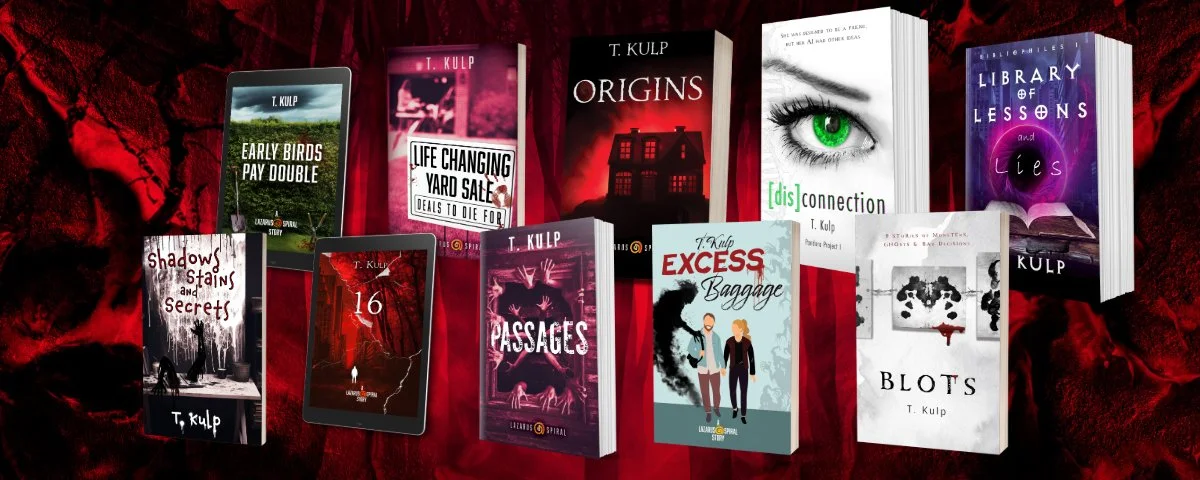
I’ve written across novels, short stories, and audio horror—works like Life Changing Yard Sale, [dis]connection, Library of Lessons & Lies, 16, and Eyes of the Observer.
The complete list of stories can be found at https://timkulp.com/stories
Some terrify through philosophy, others through silence—but all are fragments of the same widening circle of dread.
In what order should I read your books?
Each story stands on its own, but the more you read, the clearer the hidden structure becomes.
I’d recommend you start with BLOTS. It is the center of the spiral for my creative journey with stories that spanned many years in my creative journey. Specifically in BLOTS, I’d encourage you to start with OLD JACK, but all the tales roll into other stories.
Where can I buy your books or read samples?
You can find my books through timkulp.com, on major retailers, or by subscribing to my newsletter, where I share early chapters, hidden lore, and exclusive short fiction.
If you’re looking for the full experience—start there by subscribing at https://timkulp.com/newsletter-signup
Do you offer audiobooks or digital editions of your horror stories?
Yes. Many of my works are available digitally, and I’m expanding into audio dramas and immersive soundscapes through projects like Echoes in the Fog & The Eyes of the Observer.
Horror should be heard as much as read—the human voice carries terror in ways machines can only mimic. Audio stories are available on my youtube channel as well as through my store at https://MakingAdventure.fun
🔮 Creative Process & Influence
Why do you explore themes of insignificance and identity in your horror?
The themes resonate with me from growing up in a small town, exploring identity in a professional setting, and trying to figure out who I was through my life.
Whether it is Artificial Intelligence, cosmic horrors, or quantum computing - humanity is always facing a world moving faster, growing bigger, and connecting in ways we never could imagine. Horror to me isn’t about the boogie man or a monster in the shadows.
That’s the truest terror: not death, but irrelevance.
Who are your biggest horror influences?
Lovecraft taught me insignificance.
Clive Barker taught me transformation.
Stephen King taught me humanity.
But I’m equally shaped by modern philosophy, neuroscience, and the algorithms that now haunt our feeds.
I believe horror evolves with its tools—and I write where those influences collide.
How do you balance philosophy and fear in your stories?
I never separate them.
Philosophy is the skeleton; fear is the flesh.
Each story begins with a question—What does it mean to be human when consciousness can be copied?—and ends where the answer destroys the asker. The goal isn’t explanation, but revelation (another thing I learned reading Clive Barker).
What advice do you have for writers exploring AI or cosmic horror?
Don’t write about monsters. Write about people. The story is complicated by the horror / the monster, but even without the monster, there’s still a story.
Write what you know, which means lean into your experiences and do your homework beyond what’s easy to find online.
🕷️ Reader & Community
How can I join your newsletter or get early access to new stories?
Visit timkulp.com/newsletter-signup.
Subscribers receive early stories, research notes, and occasional fragments from my upcoming worlds.
It’s also where I leave breadcrumbs—symbols, dates, or phrases—that link one story to another.
Do you appear on podcasts, panels, or horror conventions?
Yes. I frequently speak about the intersection of horror, AI, and creative consciousness—how storytelling shapes the technology shaping us.
You can reach out to me through the contact page or grab information from my Media Kit at https://timkulp.com/media-kit
How can I support your work?
Read. Share. Speak. Drop a rating on Amazon.
Eventually, join my Early Readers and provide feedback to my stories before anyone else sees them. Early Readers are invite only through my newsletter subscribers.
🧩 Thematic & Philosophical
How does your work reflect modern fears about technology, control, and humanity?
We’ve traded gods for algorithms, prophets for influencers, faith for prediction.
My stories are about what happens when those predictions come true.
When control becomes illusion, and our creations begin to write the next chapter without us.
That’s where my horror lives—in the silence between command and response.