The Least You Need to Know
As you know, I’m a Dungeons and Dragons fan.
With that I’m starting to play with a lot more people and find I’m giving the same tutorial over and over. So this post is a short primer to Dungeons & Dragons. I’ll be focusing on D&D through Roll20 as I’m focusing on playing through Roll20 lately.
Let’s start with…
What is this game?
Dungeons and Dragons is a role-playing game. Role Playing games are games where you assume the identity of a fictional character and act out or talk out what the character is doing. So playing D&D is nothing more than playing pretend. You are pretending to be a character in a pretend world.
How do I play?
Starting with the simplistic answer. People who play D&D fall into one of two player types: Player Character or Dungeon Master.
Player Characters (PC)
You’re an actor pretending to be a character. You say what your character is doing and sometimes talk as if you were that character. Funny voices are encouraged. Think of it like being an actor but you say what you’re doing instead of physically doing it.
Dungeon Master (DM) (or Game Master/GM)
This player is like the stage manager for the play. The Dungeon Master (DM) is in charge of making sure the game is fun and goes according to the rules. The DM also plays all other characters in the game that are not Player Characters. The DM is like the arbiter of the rules and ultimate decision maker to keep the game moving and fun for everyone.
Image from the DMs Guild (Adventurer’s Portrait pack)
Rules
Have fun & Make sure others are having fun: I always keep this as my top rule. Have fun and make sure others are having fun which means making sure everyone has a voice. Engage each other in the game.
What is meant to be: Often the sign of D&D are dice. We use a lot of dice in D&D. The dice represent chance. There is a chance you can jump from here to that cliff ledge. There is a chance you can swing you sword and hit the troll. There’s a chance you can convince the prince to give you his kingdom. Chances are represented as a “difficulty” (how likely is something to happen) and then you roll your dice to see if it happens.
As an example: you want to jump from the dock to a boat sailing away. The DM would say that is a difficulty of 10. You’d then roll your dice to see if you get > 10. If you get > 10 you succeed. < 10, you don’t. The fun is in describing what happens success or failure and using that to keep the game going.
Remember, this game is about role-playing so:
You’d tell the DM what you want to do,
the DM would tell you the difficulty as a number
you need to roll your dice to get higher than the number the DM said.
Based on what you roll, you will find out what happens.
What are all those numbers: Yes, there are a lot of numbers and metrics in D&D. The character sheet is a visualization of your characters abilities. Remember, this character isn’t you. You might be a super fast runner but perhaps your character is super slow and prefers to smash things vs. run. Your character sheet has numbers that describe your character and those numbers will help (or hurt) your dice rolls.
The character sheet is all the things about your character. The sheet tells you how strong, how smart, how charismatic, what items you have, how experienced you are in adventuring and even things like your background. Get to know your character sheet. Have fun with it.
Take time with your DM to understand your character sheet. Give it a good read and get to know your character.
Other stuff that you don’t need to know to start: Yes, there are plenty of other things ranging from magic to combat but you don’t need any of that stuff to start. Your DM should walk you through it on your first time AND only when the situation arrives that you need to know about the “rule” in question.
Image from the DMs Guild (Adventure’s Pack)
Characters
Character creation comes down to a few things. Your DM can walk you through the process but here’s the least you need to know:
Pick a race: What kind of character are you? A human? A dragonborn? An elf? What does that mean in the world of your game? Your race is the genetic makeup of your character. Just like in real life, your genetic makeup can also impact social situations. Here’s a quick list of some basic races:
Human: you probably know this one
Elf: Legolas from Lord of the RIngs
Dwarf: Gimli from Lord of the Rings
Halfling: Frodo (and hobbits in general) from Lord of the Rings
Dragonborne: Dragon blood running through a humanoid body
Tiefling: Demon blood running through a humanoid body
Half-Orc/Half-Elf/Half-…: Cross between human (usually) and something else usually rejected by both worlds as “half-bloods" or impure.
Pick your calling: Your “character class” isn’t just a job, it is your calling. Adventurers have callings that put them on the path to adventure. You can have more than one calling but everyone starts with just one (usually :) ).
Warriors
Barbarian (tribal warrior)
Fighter (soldier)
Paladin (religious warrior)
Ranger (outdoorsy type)
Priests
Cleric (priest with a deity)
Druid (priest of nature)
Monk (uses martial arts)
Wizards
Wizard (student of magic)
Sorcerer (magic by birth)
Warlock (magic b/c of a deal with a powerful entity)
Rogues
Bard (Entertainer)
Rogue (aka Thief/Assassin)
Each class has special abilities but that all gets explained during character creation. You just need to pick one of these or be ready to know your options.
Think about who you are and where you came from: A critical but often overlooked aspect of character creation is thinking about WHO the character is. Take time to think about that. Are you a Half-Orc barbarian who is exiled from your tribe? Are you a human noble who ran away to learn the ways of a Monk? Maybe you’re a Dragonborne druid sworn to protect a mountain pass leading to paradise? Your character is more than what is on the character sheet. Take a moment to think about that. Let the thought of who your character is drive decisions about everything from ability scores (your DM will tell you about that) to what languages you speak. Have fun!
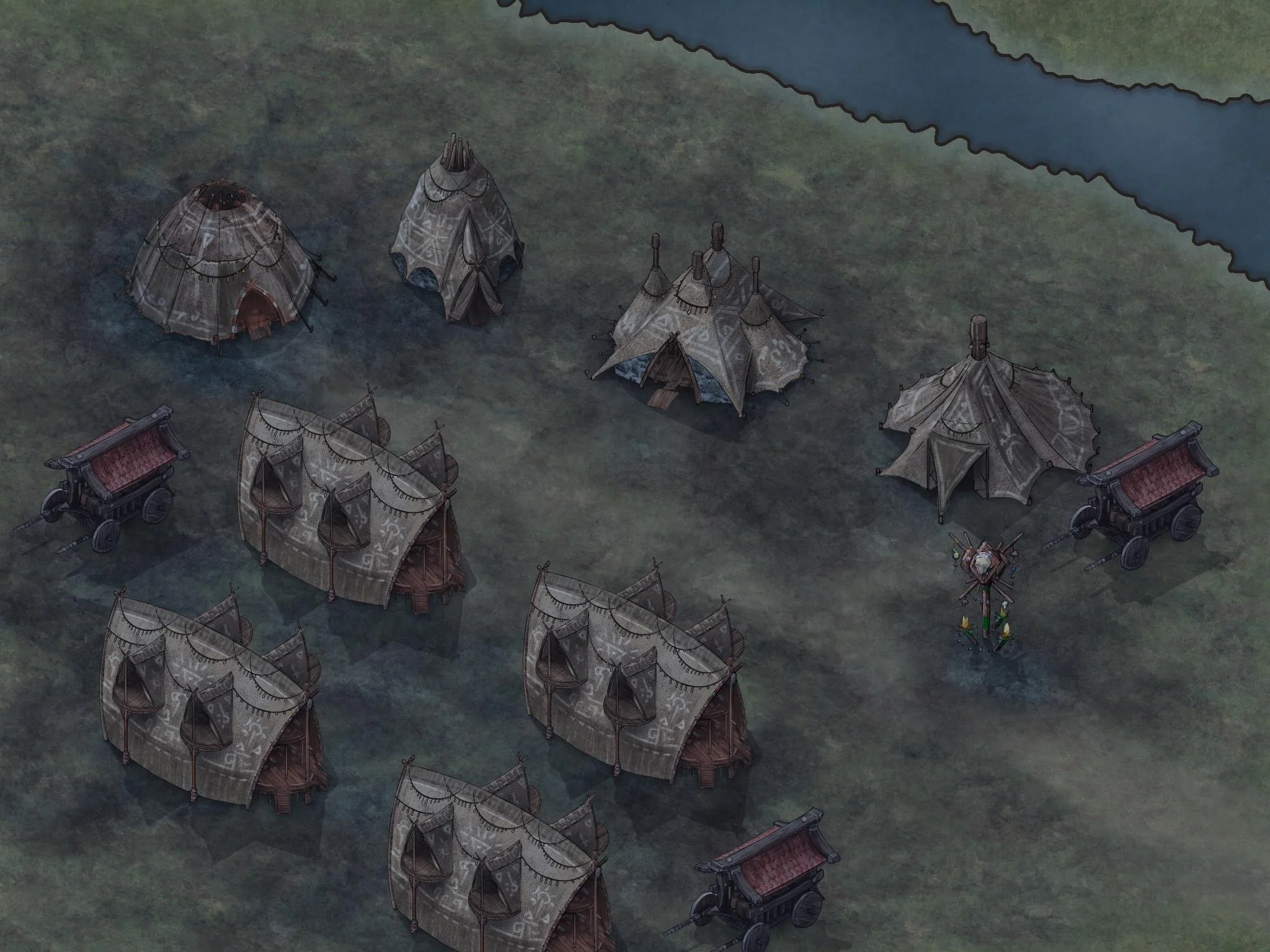
A map from a recent adventure
What to expect in your first game
Games go something like this…
DM: You’ve entered into a cave. You can see a torch in the distance straight ahead. To your right is an opening but too dark to see far. To your left is a wall. You hear dripping water somewhere in the cave. What would you like to do?
PC: Okay, I’ll go into the darkness to the right. Is that where the dripping is coming from?
DM: You can hear the dripping getting closer but it’s too dark to see far.
PC: I’ll light up a torch (found on the character sheet under “Inventory”)
DM: You light up the torch and see a goblin standing right in front of you! Roll for initiative.
PC: What’s that roll again?
DM: [Explains the roll]
PC: Rolls dice
The game continues in this conversational style with intermittent dice rolls.